From Revolutionary to Maturity
Component Manufacturing Offers a Roadmap for Construction Innovation

THE COMPONENT MANUFACTURING INDUSTRY did not begin with a sophisticated automated plant, powerful design software, or a perfectly developed business model. It began with a problem.
Framing buildings, particularly the rafters of roofs, required significant time and skilled jobsite labor. If more of that work could be performed efficiently in a manufacturing environment, builders could construct buildings faster while relying less heavily on difficult carpentry in the field. That basic idea remains at the heart of component manufacturing today.
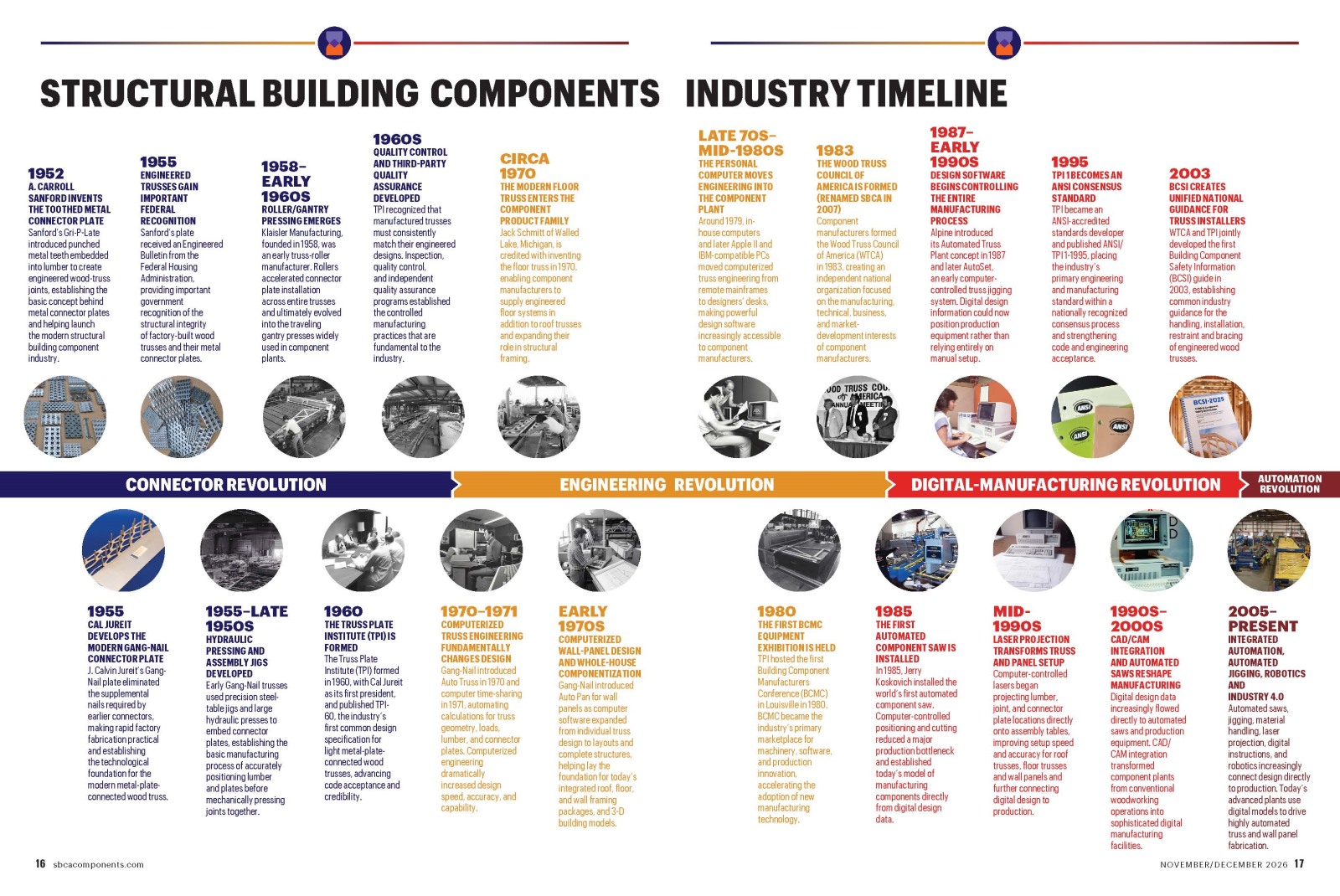
The concept of the truss itself was certainly not new when the industry began to take shape. Truss forms date back centuries. What changed everything was the development of the metal connector plate. A. Carroll Sanford developed his toothed Gri-P-Late in 1952, followed by J. Calvin Jureit’s Gang-Nail plate in 1955. Jureit’s innovation eliminated the supplemental nails required by earlier connectors and made efficient factory fabrication significantly more practical. It was a relatively simple innovation that opened the door to something much bigger.
Innovation Creates New Problems
What followed offers valuable lessons for anyone attempting to innovate in the construction industry today. The connector plate did not immediately create the mature industry we know today, but rather an entirely new collection of problems that needed to be solved.
How should trusses be designed using this new connector plate? How could manufacturers ensure they were fabricated consistently? How would building officials know they were safe? How could production become faster? How should these products be transported, handled, braced, and installed?
The industry didn’t address all these questions at once. Instead, it took several decades to work out scalable approaches that could be embraced by the market.
In 1960, the plate manufacturers in existence formed the Truss Plate Institute (TPI) and developed common design specifications that helped establish greater consistency and credibility. Quality control and thirdparty quality assurance practices followed. As the number of component manufacturers grew, manufacturers themselves eventually recognized the need for their own collective voice, first through groups operating within TPI and ultimately through the formation of the Wood Truss Council of America (WTCA) in 1983 (now known as SBCA).

That progression is as important as it is instructive. Successful innovation requires more than proving something can work. It also requires creating an environment in which people are comfortable relying on it. This is one of the reasons why the home building industry has changed very little over the last 140 years.

Technology Changes the Equation
Arguably, one of the most significant advances for the component manufacturing industry came with the emergence of the personal computer. Component manufacturers were remarkably early adopters of computerized design. Gang-Nail introduced Auto Truss in 1970 and computer time-sharing shortly afterward. By the late 1970s and early 1980s, computers were moving directly into component plants, giving designers capabilities that would have been difficult to imagine when the industry began.

Next, the connection between engineering and manufacturing became increasingly direct. The first automated component saw was installed in 1985. Computer-controlled jigging followed. Laser projection improved setup speed and accuracy. CAD/CAM integration increasingly allowed information created during design to flow directly into production equipment.
WTCA’s annual BCMC trade show became an important accelerator for many of these developments. Beginning as an equipment exhibition in Louisville in 1980, the show provided a place where manufacturers could see new machinery and software, share ideas, and learn from one another. As the industry became more sophisticated, so did the exhibition floor.
The modern component manufacturing facility is the culmination of that journey. Three-dimensional models can direct automated saws, laser projection systems can guide assembly, and highly mechanized (even robotic) equipment can handle production tasks once performed entirely by hand.
It’s important to remember those advancements didn’t happen overnight.

Maturity Comes Through Adversity
The industry’s growth has not been without its challenges. By the mid-2000s, a strong housing market fueled significant expansion. BCMC had grown dramatically, manufacturers were expanding into wall panels and other products, and WTCA evolved into the Structural Building Components Association (SBCA) to better represent the industry’s widening scope. Then the housing market collapsed.

During the Great Recession, many manufacturers were forced to close or sell their businesses, resulting in a significant contraction of the industry. Those that survived emerged leaner and stronger. This period marked another important stage of the industry’s maturation, demonstrating that innovation alone does not guarantee success. A sustainable industry requires sound business practices, strong relationships, shared standards, effective education, and an ability to adapt to changing circumstances.

Today, component manufacturing is no longer an experiment at the margins of construction. It is a sophisticated and mainstream manufacturing industry built around engineering, digital information, quality control, automation, and continuous improvement. Yet its fundamental purpose has changed very little: to move complicated work from an unpredictable jobsite into a controlled manufacturing environment in which it can be performed more efficiently and consistently.
A Roadmap for What Comes Next
This history and experience are particularly relevant today as the broader construction industry places growing emphasis on offsite construction, robotics, artificial intelligence, design for manufacturing and assembly (DfMA), digital modeling, and industrialized construction.
There is a temptation to believe the next great technology or shiny widget will transform construction by itself, but component manufacturing suggests otherwise. The connector plate was revolutionary, but that alone did not create an industry. Neither did computers, automated saws, lasers, robotics, or any other individual advancement.
The transformation occurred because hundreds of innovators spent decades removing barriers. They developed standards. They proved performance. They improved manufacturing. They educated building officials and installers. They created best practices. They shared ideas with competitors. Most importantly, they kept solving the next problem.
That may be the most valuable lesson component manufacturing can offer the rest of the construction industry. Meaningful innovation rarely occurs in a single giant leap. More often, it is the result of a long series of practical improvements that eventually change what is considered to be normal. Component manufacturers have been making that journey for more than 70 years.
And it’s not finished yet.
INTEGRATED AUTOMATION, AUTOMATED JIGGING, ROBOTICS AND INDUSTRY 4.0
Automated saws, jigging, material handling, laser projection, digital instructions, and robotics increasingly connect design directly to production. Today’s advanced plants use digital models to drive highly automated truss and wall panel fabrication.