
HUD Rolls Out Action Plan Focused on Modular Housing
Originally Published by: HBS Dealer — March 16, 2026
SBCA appreciates your input; please email us if you have any comments or corrections to this article.
The National Institute of Building Sciences (NIBS) touts the release of HUD's new report, HUD's Past, Present, and Future Role in Accelerating U.S. Offsite Construction for Housing: A Comparative Study and Action Plan. 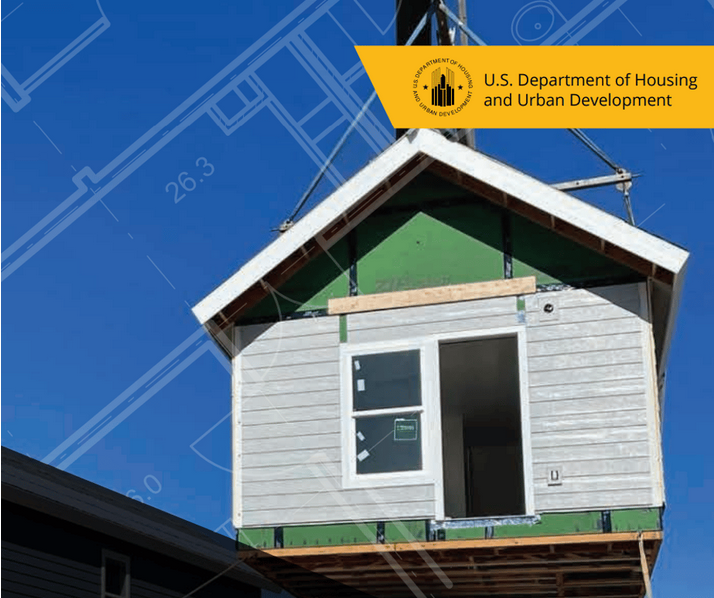
The report reviews international and U.S. case studies to identify opportunities to expand industrialized construction to help meet the nation's housing needs. Its findings conclude that offsite construction can improve quality and reduce costs when institutional and regulatory barriers are addressed, "helping protect taxpayer dollars through more efficient and predictable building processes."
The report emphasizes that HUD's role is to enable innovation by removing outdated constraints and fostering private sector leadership and growth. It also stresses that government alone cannot achieve success in this sector and that a healthy, competitive market is essential to scaling offsite building methods.
HUD's Action Plan outlines immediate, intermediate, and long-term strategies, including standard award criteria, housing system certification and performance-based building codes. By focusing on proven lessons and working closely with housing partners, the report highlights how HUD can strengthen a resilient, market-driven housing sector that benefits American families and communities.
Key findings from the study include:
- Accelerating offsite construction can quickly boost housing supply, affordability and accessibility, while also enhancing housing quality cost-effectively.
- Regulatory reform and demand aggregation are essential for scaling offsite construction across the housing sector.
- A high-tech housing industry supported by a "national innovation system" allows an offsite construction sector to operate effectively without ongoing government intervention once the ecosystem is in place.
- Education and knowledge exchange must be maintained consistently throughout efforts to speed up offsite construction adoption.
The report presents a U.S. Offsite Action Plan that structures the recommended way forward around three interconnected strategies aimed at speeding up offsite housing production:
- Standard award criteria as an immediate method to gather demand.
- Housing system certification as a midpoint mechanism for regulatory reform.
- Performance-based building codes as the long-term foundation for a national housing innovation system.
The research reflects a wide collaborative effort involving over 200 domestic and international experts who participated through workshops, research exchanges and cross-sector partnerships across government, industry, academia, and nonprofit organizations over several years. It also highlights lessons learned from similar modular initiatives in Sweden, Japan and the U.K. The move aims to remove barriers to modular building and "realize the goals of developing rapid housing supply and affordability." As HUD notes, “large-scale application of industrialized building systems … is not limited by technological, design or cost factors, but only by institutional constraints”
"Our nation's housing challenge is reaching a critical level that demands innovative, collaborative, and practical policy solutions that increase access to quality housing at every stage of life," said George Guszcza, President and CEO of the National Institute of Building Sciences. "This report provides a roadmap for how the United States can responsibly expand offsite construction to significantly improve housing affordability, safety, and resilience for all communities across America."
"Traveling and working closely with such a diverse global network of leading experts in industrialized construction has been insightful and inspiring for our entire team," said Ivan Rupnik, Founding Partner of MOD X. "This kind of collaborative effort and shared learning is not peripheral to the work – it's fundamental to how institutional change occurs – and is required to expand housing innovation in the United States."
The new report expands on the previously published Offsite Construction for Housing: Research Roadmap, which identified six major obstacles to scaling offsite construction:
- Regulatory Framework
- Standards and System Performance
- Capital, Finance, and Insurance
- Project Delivery and Contracts
- Labor and Workforce Training and Management
- Business Models and Economic Performance
MOD X and NIBS are currently applying the report's findings at the regional level across the United States to create a Housing System Certification Program Standard. The program aims to simplify approvals and support early project pilots with forward-thinking Authorities Having Jurisdiction (AHJs) and system providers.
The full report is available here.