
HydroBlok Introduces Direct-to-Stud Wall Application
Originally Published by: LBM Journal — June 10, 2026
SBCA appreciates your input; please email us if you have any comments or corrections to this article.
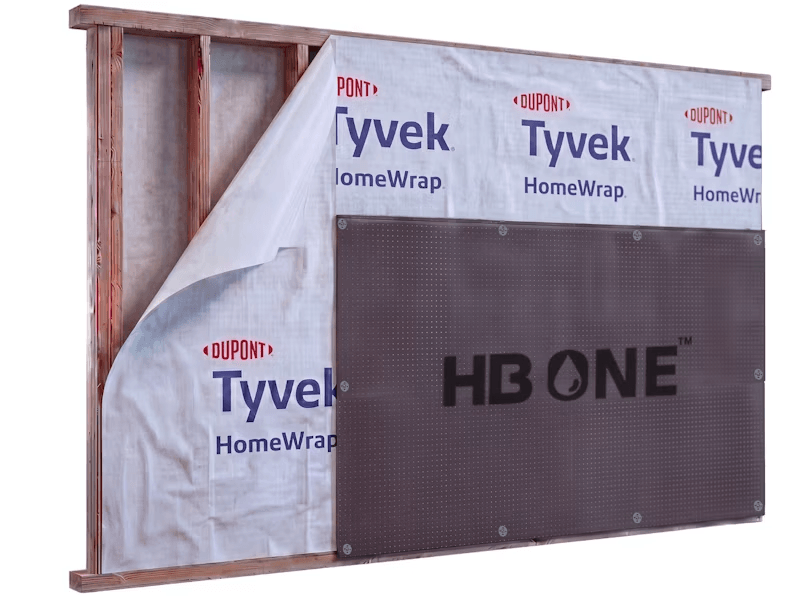
HydroBlok's has launched a direct-to-stud capability that allows construction crews to address all of those challenges simultaneously—removing layers from the wall and consolidating multiple functions into a single integrated system.
Wall complexity is increasingly code-driven. Under the 2024 International Energy Conservation Code (IECC), continuous insulation is progressively embedded into the prescriptive path for wood- and steel-framed walls to reduce thermal bridging through framing—part of a steady tightening that has moved continuous insulation from an optional upgrade to a routine path to compliance. As energy codes continue to tighten, continuous insulation is increasingly central to code-compliant construction.
With the new direct-to-stud capability, HB One Backer CI can be installed directly to wood framing in designated non-shear wall sections, covering around 80% of the wall surface. The product itself did not fundamentally change. Rather, its role in the wall assembly has been approved to evolve. Structural sheathing continues to be used wherever it is required by engineering, code or project conditions, such as shear and braced-wall lines. This expands where the panel can be applied without changing the structural requirements that govern those areas.
"This is one of the most disruptive changes to exterior wall construction in decades," said Colin House, CEO of HydroBlok. "The industry has been moving toward more complex walls driven by energy codes and continuous insulation requirements, and HydroBlok Direct-to-Stud changes that equation. Builders can now remove a layer from the wall — simplifying stucco installation while achieving a built-in path to energy-code compliance — all with a single integrated system."
For stucco—among the fastest-growing exterior cladding segments in residential construction—HB One Backer CI integrates a secondary water-resistive barrier, continuous insulation, lath and scratch coat into a single panel. The new direct-to-stud capability adds another functional layer by allowing the panel to serve as the non-shear substrate in approved assemblies. This evolved system creates a 5-in-1 panel that further simplifies the wall while reducing the trades, layers and labor traditionally required for stucco.
For mechanically fastened cladding such as fiber cement and vinyl siding, HB One Backer CI is compatible with siding manufacturers' prescriptive continuous insulation installation methods. Builders gain continuous insulation and a secondary water-resistive barrier in a single layer, while their cladding installs in a familiar process.
"What makes this meaningful is that it simplifies the wall without requiring crews to relearn how they build," said Alex Gillespie, chief product officer at HydroBlok. "Energy codes are making continuous insulation a standard requirement, yet builders don't desire increased complexity. HB One Backer CI delivers continuous insulation, water management and stucco simplification in fewer layers — and a familiar install sequence — making high-performance walls easier to build, not harder."
HB One Backer CI is recognized for code compliance through ICC, with full evaluation documentation for the direct-to-stud application forthcoming. Builders, architects, engineers and code officials should reference applicable ICC documentation, local code requirements and project-specific design conditions when evaluating assemblies.