
Major Housing Bill Becomes Law Without President’s Signature
Originally Published by: Wall Street Journal — July 11, 2026
SBCA appreciates your input; please email us if you have any comments or corrections to this article.
A landmark housing bill designed to address voters’ affordability worries became law Saturday despite President Trump’s refusal to sign it, as he continued to protest the lack of action on his sweeping voter-ID proposal that has stalled in the Republican-controlled Congress.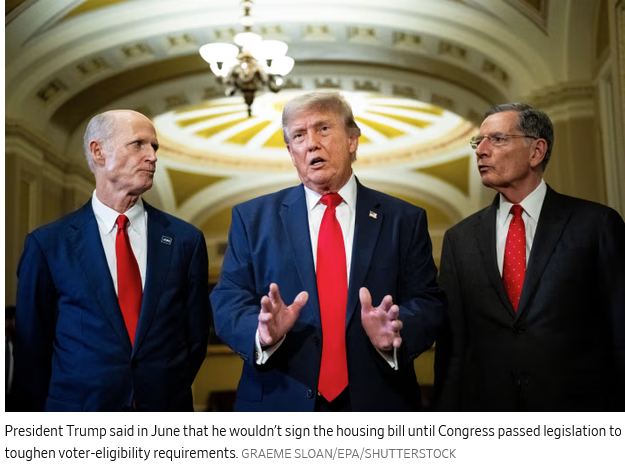
In a social-media post on Friday, the president said he would refuse to sign the housing bill because Congress hasn’t yet passed separate legislation that would mandate proof of citizenship to register to vote as well as voter ID nationwide, known as the SAVE America Act. Trump has been pressuring the Senate to pass the bill for months, but top Republicans in the chamber say it doesn’t have enough support.
“THE SAVE AMERICA ACT’S non-passage is CRAZY, and a serious threat to any politician who votes against it!” Trump wrote on Truth Social.
Republican House Speaker Mike Johnson (R., La.) transmitted the housing bill to the White House on June 29, starting a 10-day clock, excluding Sundays, for the president to sign the bill, veto it or let it become law without his signature.
It is rare for bills to become law without the president’s signature. In 2016, President Barack Obama allowed an Iran sanctions bill to become law without his approval. Back in 1995, President Bill Clinton declined to sign or veto a bill requiring the U.S. to move its embassy to Jerusalem, subject to national-security waivers, allowing the measure to become law
Congress passed the housing measure with big bipartisan majorities. But the president canceled the original signing ceremony last month and said he wouldn’t sign the bill until Congress passed stalled legislation to toughen voter-eligibility requirements. On top of the core voter-ID provisions, Trump wants to ban most mail-in voting nationwide. He also has demanded provisions ending transgender women’s participation in female sports and ending gender-related treatments for children.
Trump’s decision blindsided lawmakers who had been ready to declare the housing bill a rare bipartisan victory on a popular issue squeezing voters’ budgets. Real-estate industry leaders were also thrown off by the last-minute cancellation after they spent months lobbying to ensure certain provisions wouldn’t negatively affect their businesses.
The housing bill includes 50-some provisions aimed at making it easier to build homes and boost housing affordability. Home builders and developers say it could help at the margins. But most of the obstacles to housing production revolve around local zoning and building regulations that the federal government doesn’t have the authority to overhaul.
Still, four months out from the midterm elections, federal lawmakers are banking on this new law to show voters they are trying to address the high cost of living.
The White House was looking to tout the legislation because it included a ban on institutional investors buying single-family homes, which Trump pushed for earlier this year.
Even with Trump’s vow not to sign the bill, housing leaders prepared for it to become law. They are also trying to ensure that it doesn’t fizzle out as it gets implemented.
National Housing Conference Chief Executive David Dworkin said his organization is using artificial intelligence for analyzing the bill’s provisions to offer the administration a blueprint for implementation as quickly as possible.
“The worst thing would be for us to pass this bill and then nothing happens,” he said.
After midnight, lawmakers from both parties issued statements cheering the new law.
“This is good legislation that will have a real, positive effect on families in South Dakota and across the nation,” said Sen. Mike Rounds (R., S.D.).
“This bill has become law in spite of, not because of, the president. It’s shameful,” said Sen. Ruben Gallego (D., Ariz.). “But today is still a historic day worth celebrating. ”