
QXO Reveals Where It Is Now and Where It's Heading
Originally Published by: Webb Analytics — November 12, 2026
SBCA appreciates your input; please email us if you have any comments or corrections to this article.
QXO Chairman and CEO Brad Jacobs jumped the gun Nov. 9 on the company's third-quarter results by releasing both preliminary financial results (a net loss iof $123 million and adjusted EBITDA of $557 million on $4.9 billion in net sales) as well as extensive, effusive comments on what the company is doing.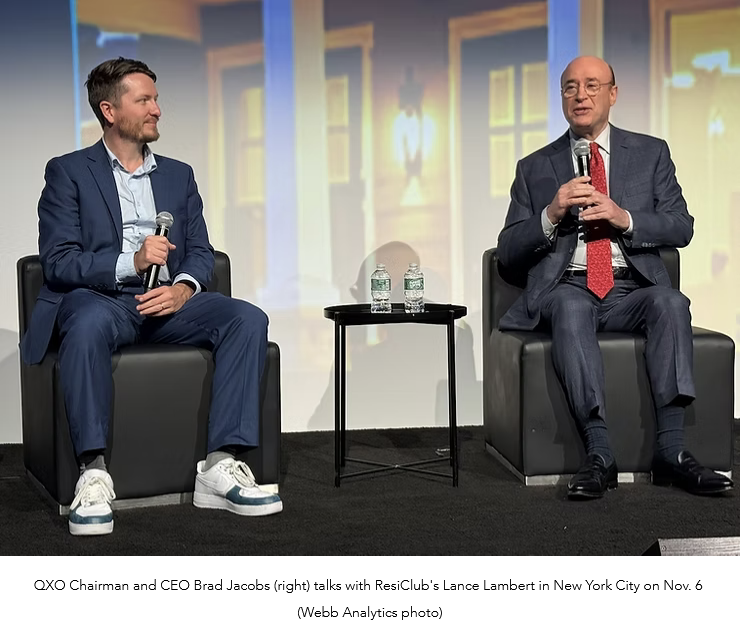
In comments to stock analysts, Jacobs said "My enthusiasm for this company is sky high," and he presented several data points to show why:
-
Companywide, year-over-year pricing improved by 400 basis points, from negative 1.7% in April to positive 2.3% in September. "We’ve instilled more rigorous governance over excessive price overrides and improved the tools, management, and incentives that support pricing decisions," he said. Improved customer service also helps enable higher pricing, he said.
-
October's daily sales for all of QXO grew 5.4% year-over-year. Roofing and waterproofing daily sales last month rose 9.1%.
-
Face-to-face customer meetings increased 57% from July to early November.
-
The percentage of roofing and waterproofing products delivered on time grew 650 basis points. "A third of our regions are already exceeding our 95% on-time delivery target," he said.
-
Out-of-stocks improved more than 25%. Invoice accuracy went from low 90s at the start of 2026 to high 90s in Q3.
-
Sales of complementary roofing and waterproofing products grew 4.2% year-over-year, gutters were up 16%, fiber cement 15%, and windows 7%.
-
Jacobs is a big fan of private-label products. Roofing and waterproofing products accounted for 10.6% of sales in Q3, up from 10.1%. The company's TRI-BUILT brand had $943 million in sales in the 12 months ended Sept. 30. Jacobs thinks it can grow sales to $2 billion.
On Nov. 6, Jacobs said QXO is using AI-powered bots for procurement. "We have 200 vendors competing online," Jacobs told ResiClub's Lance Lambert during ResiDay in New York. "The bot can set up the RFP, do the tender, award the tender, and help with logistics.”
QXO's goal is to grow adjusted EBITDA to $4 billion by 2030 from the approximately $1.75 billion "reflected in current consensus estimates" by analysts. "Between now and 2030, we estimate that acquisitions we can fund with internally generated cash flow could contribute up to $1.5 billion of additional EBITDA, taking the total EBITDA opportunity to approximately $5.5 billion by 2030," Jacobs said.
Jacobs also stressed that he remains "intensely committed to QXO" even as his family office invested $900 million in CKX Lands, a Lake Charles, LA-based real estate company., while co-investor Heritage Partners Group (formerly Sequoia Heritage) will invest $100 million. "CKX will be renamed and operate as a standalone public company platform in an industry to be determined," Jacobs and CKX said in a news release.
As for efforts under way, Jacobs pushed cross-selling initiatives among QXO's three units: TopBuild and Kodiak Building Partners, acquired this year; and the former Beacon Building Products, purchased in 2025. He said that of the $11 billion in goods and $1 billion in services bought company-wide, roughly $7.6 billion of those purchases is with companies serving at least two of the units and $5 billion is with all three businesses. "These existing supplier relationships represent opportunities to align pricing, rebates, and contract terms, and to negotiate using our combined purchasing power," Jacobs said. "We’re pursuing these opportunities through coordinated negotiations, supplier consolidations, stronger rebate capture, and wider adoption of common purchasing agreements."
A pilot cross-selling project in Tampa, FL, where QXO serves 18 trades, is "achieving early success," he said. QXO estimates it has about 194,000 unique customers, almost none of whom buy all of QXO's product offerings. That includes "tens of thousands" of dorman accounts, including 2,000 used to buy nearly $500 million with QXO's legacy companies.
As for technology, QXO is implementing a new ERP system, a proprietary point-of-sale system, an upgraded CRM platform with advanced AI capabilities, and a warehouse management system, Jacobs said. "We’re also integrating tools for pricing and procurement, fleet technology, e-commerce, and human resources. When this is fully rolled out, our employees will be able to get their work done in one connected, AI-enabled environment."
Field tests already are under way, he said. "The vast majority of revenue" from the legacy holdings should be on the new platform over the next year, Jacobs reported.
Year-over-year financial comparisons are difficult betcause QXO didn't own TopBuild or Kodiak in 2025's third quarter. Before those acquisitions, in 3Q25, QXO posted a net loss of $139 million and adjusted EBITDA of $301 million on $2.7 billion in net sales. Thus, net margin shrank to a negative 2.5% from a year-earlier negative 5.1%, and adjusted EBITDA margin rose to 11.4% from 11.1%.
Full results for the quarter were to be released after the market closes on Nov. 12.
During the wide-ranging session, Jacobs also said QXO is seeking to take advantage of insulation sales at data centers by its TopBuild subsidiary to promote sales of products from other QXO units. "We’re the No. 1 supplier to data centers of insulation.," he said. “I want to use that opportunity to say ‘What about doors? What about windows, What about roofs?” But when asked about how many roofing sales to data centers have resulted to date, Jacobs replied, "Not much."
While QXO has zoomed from basically zero to $18 billion in sales in a couple of years, and even though Jacobs' goal is to hit $50 billion and grow from there, he said he doesn't think small and medium-sized businesses in construction supply will go away.
“I’m a believer in the power of smaller companies,” in part because they can be more entrepreneurial than a big operation. In addition, the arrival of artificial intelligence "will level the playing field to some extent," he said.
Right after that, a person in the audience asked for advice on how to grow his 8-figure company into a 9-figure company.
"I would sell it to me," Jacobs joked. He then laid out a series of steps to understand the market, the customers, and the competition. After that "I’d redesign my biz plan to do that so that, whatever my competitors do, I can be better than that," he said. In addition, you should get every employer to think like an owner, behave like an owner, and "be wildly impassioned about giving a high level of service," he advised.
+++
Late Nov. 12, QXO confirmed in its formal 10Q report to the SEC that it incurred a net loss of $123 million and adjusted EBITDA of positive $557 million on $4.9 billion in revenue.
What's new was that QXO said TopBuild contributed $1.64 billion and Kodiak $589 million of the $4.9 billion in total sales. That leaves $2.67 billion for Beacon. In 3Q25, TopBuild (then an independent company) reported $1.39 billion in revenue. Kodiak was a private company in 3Q25, so we don't know how it did then. QXO's sales in 3Q25--basically entirely Beacon--was $2.73 billion.
Thus, at least two of QXO's three units had sales declines year-over-year.
The 10Q also revealed the company recorded a $2 million operating profit in the June-to-September period. It was a more than quadrupling of interest expenses that was the biggest factor in its $123 million net loss.
"We’re on track to reach $4 billion in adjusted EBITDA by 2030 from the businesses we already own and $50 billion in annual revenue within the decade through organic growth and disciplined acquisitions,” Jacobs said in a news release.
The balance sheet shows $34.47 billion in assets, of which goodwill makes up $14.54 billion of the total. Nearly $8.95 billion of the $15.85 billion in liabilities consists of long-term debt.
* [This story was updated late Nov. 12 to include QXO's formal third-quarter earnings report. That information is at the bottom )
By Craig Webb