
SBCA Knowledge Center: A Valuable Hub of Industry Resources
Originally Published by: SBCA — January 13, 2026
SBCA appreciates your input; please email us if you have any comments or corrections to this article.
Over time, SBCA has produced a wealth of trusted resources, guidance, and industry knowledge for component manufacturers and the broader industry community. Now, all of that information lives in one easy-to-use, free, and publicly accessible hub: the SBCA Knowledge Center. Created to provide a single destination for credible, practical, and timely information, the Knowledge Center makes it easier than ever to find the tools and insights needed to build better.
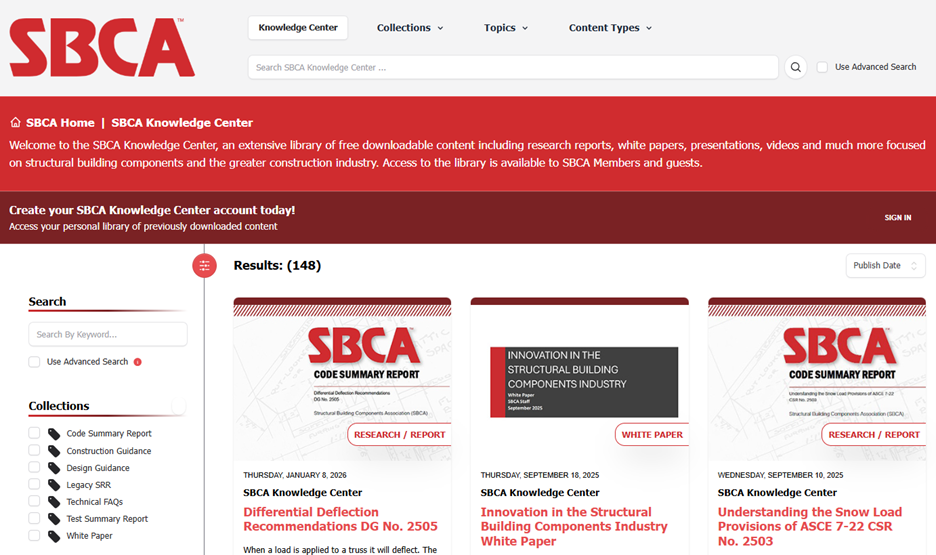
The SBCA Knowledge Center is an extensive library of over 150 free downloadable content including research reports, white papers, presentations, videos and more focused on structural building components and the greater construction industry. This vast library of technical resources is a valuable cache of knowledge for building designers, truss designers, truss installers, building inspectors, and industry professionals.
The technical documents on the SBCA Knowledge Center are broken into six primary categories:
- Code Summary Reports (CSR####) – Summarizes relevant provisions in the codes and reference standards to explain a topic (Ex. Snow load requirements in ASCE 7-22).
- Technical Notes (TN####) – Explains technical topics (Ex. Effects of corrosion on metal plates).
- Test Summary Reports (TSR####) – Summary of test results (Ex. Fire test data).
- Design Guidance (DG####) – Summary of design information for a specific topic (Ex. Deflection limits for floor trusses).
- Construction Guidance (CG####) – Provides prescriptive design information and installation details (Ex. Deck ledger connection details).
- White Paper (WP####) – Summarizes SBCA’s interpretation and position of an industry related topic (Ex. Quality systems).
Here are six examples that illustrate the scope of documents currently free for reference and download on the SBCA Knowledge Center (click the link to download the document):
Differential Deflection Recommendations (DG No. 2505) 
Structural floor or roof trusses are typically placed in a spaced pattern as part of the supporting structure. When the loading, span, or geometric properties of these trusses vary, the resulting deflection will vary as well. The difference between the deflection of adjacent trusses is called differential deflection. When the differential deflection is high it can cause cracking in finish materials or even result in structural performance issues. This guide will discuss differential deflection and provide recommendations to limit its impact on the structure.
Understanding the Snow Load Provisions of ASCE 7 (CSR No. 2503)
The latest version of ASCE 7 is the 2022 version which includes changes to the snow load provisions. This version of ASCE 7 is referenced in the 2024 version of the International Building Code (IBC) and International Residential Code (IRC). It is extremely important that truss technicians and truss designers understand these snow load changes, ensuring that the proper type of load (service level vs. ultimate) is being used in the truss design, as well as understanding how the ASCE 7-22 utilizes Risk Categories, Thermal Factors, and Winter Wind Parameters.
ANSI/TPI 1-22 Person Loading Requirements (CSR No. 2504)
ANSI/TPI 1-2022 has added a new person loading check in Section 6.2.2.5 to represent the occurrence of a person on the chord of a truss. This provision only applies to chords not sheathed with structural wood sheathing. The provision was introduced to enhance safety by ensuring that truss chords can support a worker during temporary conditions, such as access for maintenance or installation activities.
It is important for truss technicians and truss designers to understand this provision and the potential impact it may have on truss designs. In some instances, the provision may control the design of a truss chord resulting in larger member sizes, or smaller panel lengths than previously required.
Bracing Requirements for High Compression Force Web Members (CG No. 2502)
The new BCSI-2025, Guide to Good Practice for Handling, Installing, Restraining and Bracing of Structural Building Components includes some updated prescriptive recommendations. One of the changes provided in the new guide is bracing recommendations for truss web members, particularly ones with a higher compression force.
This report will cover the new web member plane permanent diagonal bracing recommendations included in Chapter 5 - 2x Truss Permanent Bracing of the new guide. Examples from various software manufacturers will be presented to assist the user in understanding how to use the updated recommendations.
Attachment of Residential Deck Ledger to Metal Plate Connected Wood Truss Floor Systems (CG No. 2501)
This research report provides construction details for residential deck ledger attachment to metal plate connected wood truss floor systems. The applicable codes and standards follow the 2024 International Building Code (IBC) and the 2024 International Residential Code (IRC). Proper attachment of the deck ledger to the house is critical for ensuring that an “attached” deck is safely and securely supported at this location. This report provides details for attaching a 2-inch nominal lumber deck ledger to residential floor systems constructed with metal plate connected wood floor trusses.
Explore all the documents on the SBCA Knowledge Center at https://kcenter.sbcacomponents.com/.