
Why the ‘Missing Middle’ Will Continue to Be Missing
Originally Published by: Builder — May 22, 2026
SBCA appreciates your input; please email us if you have any comments or corrections to this article.
For many Americans, the dream of homeownership remains increasingly out of reach as housing costs continue to rise and attainable options remain limited. For builders and developers, the solution is more complicated than simply building more homes.
Research from the National Association of Home Builders (NAHB) finds that regulations account for nearly 25% of the cost of a single-family home, contributing in part to higher home prices. At the same time, restrictive zoning in many jurisdictions limits density and prevents the production of missing middle housing such as townhomes and duplexes that can offer more attainable price points.
As affordability concerns intensify, localities across the country are evaluating regulations to find solutions to unlock more affordable housing options. In Denver, the community-led Unlocking Housing Choices initiative is pushing for updates to the city's zoning code to allow more missing middle housing forms. In Colorado, one of the broader challenges for builders is that attached housing products often come with higher development and construction costs, making it difficult to truly deliver these products at attainable price points. Matt Childers, vice president of land at Dream Finders Homes and lead for land operations at Uplands Colorado, says it is "encouraging" to see more collaborative conversations around how policy, development standards, and housing goals can align to support more attainable housing options.
While policy reform can create the opportunity for additional housing, it alone does not guarantee production.
"Zoning reform can help address affordability and inventory challenges, but development code is often far more important when it comes to attainability," says Childers. "When people think about zoning reform, they typically think about creating more flexibility for increased density. That can be helpful, particularly if the added density still allows for single-family detached product."
For builders attempting to deliver attainable housing, however, the largest obstacles often emerge after zoning approval. Children says rising infrastructure costs, stringent development standards, and permitting fees continue to challenge the financial feasibility of middle-density housing across Colorado. These costs can alter the economics of attainable housing production. Childers says developing a 50-foot homesite in Colorado can cost roughly 2.5 to 3 times more than in states like Texas. Permit fees are also restrictive in Colorado; Childers says these costs can exceed $50,000 per home and, in certain communities, surpass $100,000.
"Those higher upfront development costs ultimately flow into final home pricing and directly impact housing attainability for buyers," Childers says. "Permit fees in other states are often below $10,000 and typically remain under $20,000 per home. These costs add significant pressure to housing affordability.
While policymakers often focus on density allowances, for builders the success of missing middle projects often depend on whether deals can realistically pencil. While zoning may support townhome and duplex production, the combined costs of permitting and development make it challenging to deliver these products at attainable price points. Collaboration that focuses on consistency, streamlined processes, and development standards for attainable product will play a meaningful role in helping Colorado deliver more missing middle housing options, Childers says.
"Many missing middle and higher-density housing projects ultimately succeed or stall based on financial feasibility," Childers says. "In today's market, lenders are taking a more disciplined approach to underwriting, which means projects need to demonstrate strong long-term viability and well-aligned economics in order to secure financing and move forward."
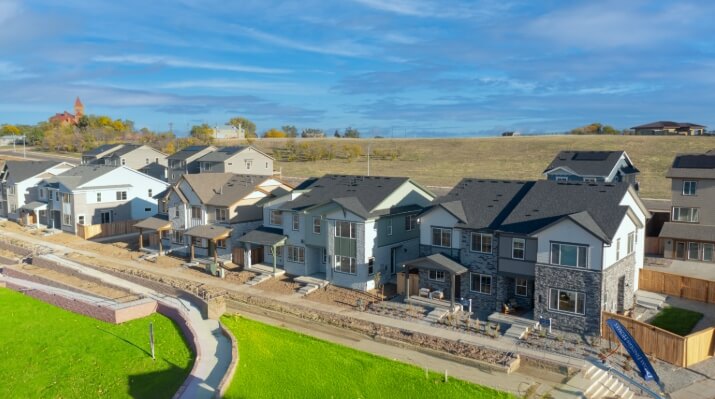
Within Uplands Colorado, a master-planned community in the Denver metro, Dream Finders Homes is navigating these challenges by introducing a broader mix of housing types, including lower price-point townhomes designed to expand attainability.
"Project feasibility improves when local governments and utility districts are open to development standards that support more efficient land use and infrastructure planning," Childers says. "That can include things like lower permit fees for attached units, more flexible site planning standards, and requirements that are better aligned with attainable housing goals."
Within communities such as Uplands Colorado, product standardization and repeatable design can play an important role in helping make missing middle housing types more attainable at scale. Operational efficiency, Childers says, is one of the biggest contributors to affordability.
When layering density into communities, Childers highlights it is important to align these new product types with community expectations around design and livability by prioritizing parks, trails, gathering spaces, and walkability. These community elements can help make higher-density housing feel more integrated into existing neighborhoods.
"When density is paired with thoughtful placemaking and lifestyle-driven design, it tends to feel much more integrated into the surrounding neighborhood rather than disruptive to it," Childers says. "From a builder perspective, those community-focused elements are often key to helping residents feel more comfortable with growth and change while still preserving neighborhood character."
The efforts to reform zoning in Denver is a promising example of legislation to remove red tape for builders and promote a diversity of product types. To effect meaningful change, though, will require continued collaboration between municipalities, developers, and builders.
"If jurisdictions want more middle-density housing delivered at attainable price points, the development standards need to support that outcome financially, not just conceptually," Childers says. "As housing demand continues to grow, creating more practical and financially viable pathways for new construction will be critical to ensuring missing middle housing can be delivered at meaningful scale over the long term."