
A Look at Markets Where Home Buyer Age Skews Younger
Originally Published by: Builder Online — May 15, 2026
SBCA appreciates your input; please email us if you have any comments or corrections to this article.

New data from the U.S. Census Bureau shows that the median age across major U.S. housing markets edged higher between 2019 and 2024. The increase is modest, typically about one year across large metros, but it reinforces a broader demographic shift that builders can no longer ignore.
This is not a sudden aging wave. Instead, it is a gradual shift with meaningful implications for housing demand, product mix, and long-term strategy. In most major markets, the median resident is now older than just five years ago, signaling a steady evolution in the buyer base.
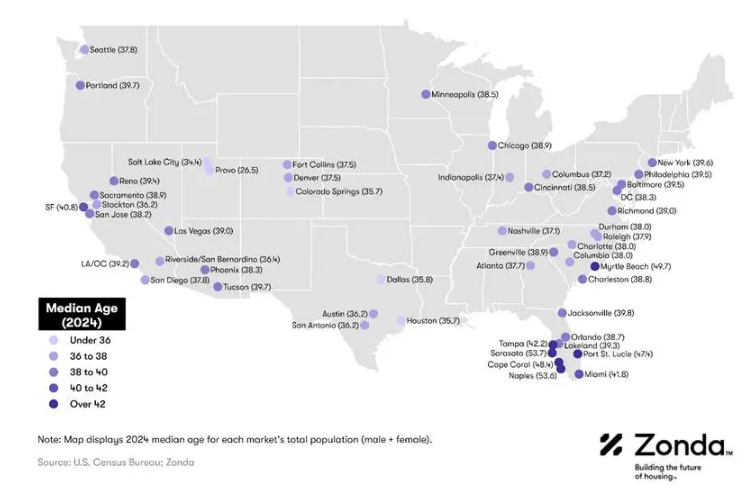
Across large coastal and Midwest metros, median ages are now tightly clustered in the upper 30s to low 40s. Markets such as Seattle, Chicago, Minneapolis, and Philadelphia all saw incremental increases, pushing closer to age 39. San Francisco stands out, with median age surpassing 40. These trends reflect slower household formation, aging millennial cohorts, and fewer younger households offsetting older residents, particularly in high-cost markets.
Some Markets Still Skew Young
Despite the national trend, several markets remain structurally younger. Provo, Utah, continues to post the lowest median age, holding in the mid-20s even after slight increases. Salt Lake City also remains comparatively young, along with much of Texas. Dallas, Houston, San Antonio, and Austin all recorded median ages in the mid-30s as of 2024.
For builders, these markets carry outsized importance. Younger populations tend to drive higher household formation rates, stronger entry-level demand, and more consistent absorption of first-time buyer product. Even with incremental aging, their long-term growth profiles remain intact, especially when supported by in-migration and job growth.
Retirement and Lifestyle Markets Pull Older
At the opposite end of the spectrum, Florida markets dominate the oldest median ages in the dataset. Sarasota, Naples, Cape Coral, Port St. Lucie, and Myrtle Beach all posted median ages well into the upper‑40s or 50s by 2024, with several continuing to age further over the past five years. These markets remain magnets for retirees and second‑home buyers, reinforcing demand for age‑targeted product and amenity‑driven communities.
Notably, some Florida markets saw slight declines or stabilization in median age, suggesting incremental diversification as younger households move in for affordability or remote‑work flexibility. Even so, the overall age profile remains significantly older than the national metro average.
Why Median Age Matters for Product Strategy
For builders, median age is not just a demographic statistic; it is a signal about buyer priorities. Older markets tend to favor smaller households, lower maintenance homes, and communities with lifestyle amenities, while younger markets require attainable pricing, flexible layouts, and proximity to employment.
Overall, the 2024 Census data reinforces that there is no one‑size‑fits‑all demographic story. While the country is aging overall, migration patterns, affordability, and local economic drivers continue to shape markets in very different ways. Builders who align product with the age profile of their buyers, rather than relying on national averages, will be best positioned to compete as demographic headwinds intensify.