
Housing Bill Set to Become Law Without President’s Signature
Originally Published by: Reuters — June 28, 2026
SBCA appreciates your input; please email us if you have any comments or corrections to this article.
WASHINGTON, June 28 (Reuters) - U.S. House of Representatives Speaker Mike Johnson said on Sunday he would send a bipartisan housing affordability bill to Donald Trump on Monday, days after the Republican president refused to sign the bill until a divisive voting rights measure was passed. 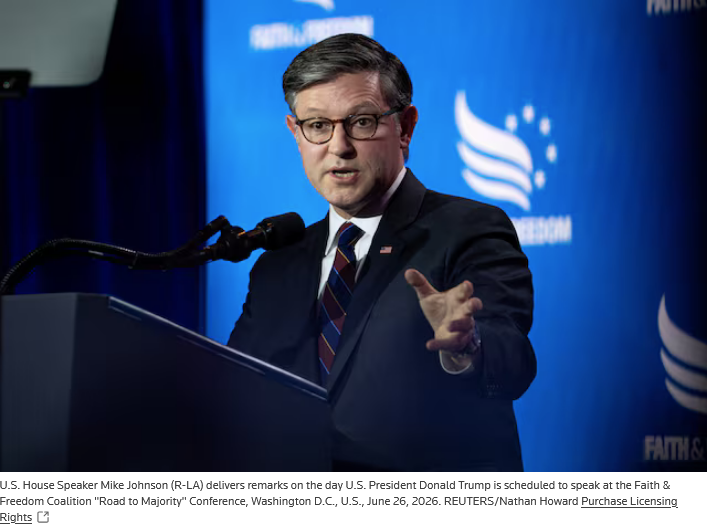
"It's passed by both chambers. I'm sending it to him on Monday, and it will become law," Johnson, a Republican from Louisiana, said on Fox News' "Sunday Morning Futures" program.
Trump on Wednesday abruptly canceled a signing ceremony for the housing legislation in an effort to pressure Republicans into passing a controversial voter ID bill, known as the "SAVE America Act."
The voting act would require a photo ID to vote in federal elections and proof of U.S. citizenship to register, while compelling states to turn over their voter registration rolls to the federal government. The bill, which faces vehement opposition from Democrats, passed the House of Representatives in February but has since languished in the Senate.
Johnson met with Trump on Thursday to discuss a legislative path forward for the voting act and rescheduling the housing bill signing.
Trump supporters want to include the SAVE America Act in a special budget reconciliation bill that can pass the Senate with 51 Republican votes and overrule the parliamentarian — the official charged with upholding chamber rules — if the voter ID measure is ruled ineligible, as it was earlier this year.
Democrats say the voter ID law is designed to make it more difficult to vote for thousands of Americans, particularly those in heavily Democratic districts.
Because the housing bill was passed by both houses of Congress, it could become law whether Trump signs it or not. Under the Constitution, after receiving the bill, the president has 10 days to sign or veto the bill, and if he declines to do either, it would become law without his signature.
Johnson said he had met with Senate Majority Leader John Thune of South Dakota and implored him to pass the voter ID measure.
"He's got a big challenge on his hands, of course, and I've encouraged him to do everything possible within his power to move it. I believe he will," Johnson told Fox. "We'll send them over a provision that fits."