
Inside the BFS Acquisition of Pleasant Valley Homes
Originally Published by: HBS Dealer — March 3, 2026
SBCA appreciates your input; please email us if you have any comments or corrections to this article.
Off-site manufacturing is a big part of Builders FirstSource’s revenue stream. About 48 percent of the company’s business derives from making things—like trusses, pre-hung doors, off-site millwork packages—in a factory environment.
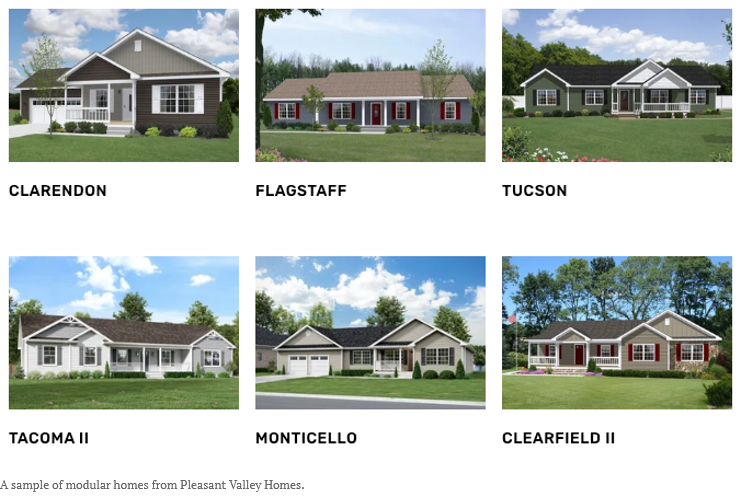
But building a full-blown modular home is another kettle of fish. And that’s why there’s interest in BFS’ acquisition in November of Pleasant Valley Homes, the Pine Grove, Pennsylvania-based wholesale modular home producer that operates in 10 states and builds about 400 houses a year.
During the company’s recent fourth-quarter earnings call, BFS described the acquisition as “an expansion of our prefabricated component strategy to address challenges facing the homebuilding industry such as affordability and access to labor with a cost-competitive factory-built option, which reduces builder cycle times.”
In an interview with HBSDealer, CEO Peter Jackson described the move less as an embrace of the modular-home mindset and more as an experiment in manufacturing efficiencies and as a potential solution for its builder customers.
Pleasant Valley will continue sales, but the BFS vision is to find partnerships with builders. BFS says it has no interest in becoming a traditional modular home seller.
“I love home buyers, but they're not my customer,” Jackson told HBSDealer. “So my job here is to come up with a solution that meets the needs of the home builders to be able to bring solutions to the job site and to turn that into an occupied home as quickly and as efficiently as possible.”
BFS says it will specifically, at first, use new factory capacity to offer modular plans to existing home builder customers. And more generally, as time goes on, learn how to partner with home builders to give them what they want.
The Pleasant Valley Homes web page (which now sports the BFS logo), describes itself as a family business with more than three decades of experience.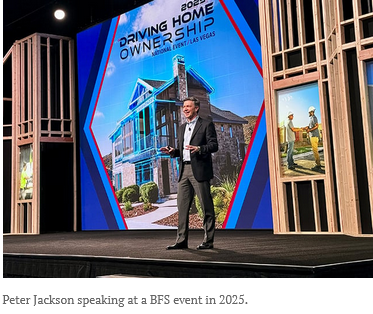
“Every home we build is designed and precision-engineered in-house and constructed in our state-of-the-art manufacturing facility,” the company’s bio reads. “We combine unparalleled construction specifications with superior design, the latest technology and skilled craftsmanship to provide builders and their homebuyers with a home that is simply better-made, energy-efficient and that offers superior comfort and value.”
The concept of modular homebuilding has been percolating inside Builders FirstSource for awhile. Back in 2023 at the BFS investor meeting, modular homebuilding appeared along the continuum of services that the company was exploring.
Jackson said the appropriate due diligence went into the purchase of Pleasant Valley. “We weren’t looking for a fixer upper,” he said.
Factory-built modular homes represent less than 1 percent of the total U.S. home stock. And they’re getting better, both in design and quality. A factory built environment offers clear advantages over a weather-exposed job site. Still, the idea of a modular revolution has been often discussed, but slow in developing.
Moreover, there have been some famous failures in the field. And if there’s a lesson in the bankruptcies of the vertically integrated factory-built home builders such as Katerra, Veev and Modulous, Jackson thinks it lies in the way those companies attempted to both compete with homebuilders and sell to homebuilders.
“I believe in this idea of offsite fabrication that we can take out inefficiencies,” said Jackson, whose career is distinguished by roles in heavy manufacturing at General Electric and Lennox, “We can introduce tooling. We can find ways to invest to make the home building process more efficient. And also we can fill that capacity by offering it to all the home builders—just like we do with the truss plant or with the door shop. That's the vision. That's the reason for the experimentation.”
Several ideas combined together to encourage BFS down the path to acquire Pleasant Valley Homes. One is the BFS’s confidence in its ability to run manufacturing plants. Another is its expectation that the homebuilding industry will continually move toward off-site manufacturing in ways that make sense for builders. Another is the industry’s near-universal drive toward affordability.
“Affordability is the prime enemy for all,” said Jackson. “And I think builders are very interested. We intend to experiment. And if we can come up with a formula, maybe we'll expand to more markets. But for the time being it's an experiment.”
The experiment in the modular world is just one of the initiatives playing out at BFS. In October it acquired both Builder's Door & Trim and Rystin Construction, which together formed the leading provider of door and millwork capabilities in the Las Vegas area. In November, it acquired Lengefeld Lumber, a supplier serving Central Texas.
And Looming over everything is the larger story of technological innovation, playing out at BFS and the broader industry.
Jackson told HBSDealer: “Our ability to improve accuracy, to improve speed, and to improve our interconnectedness—It's a powerful thing.”