
QXO’s March to $50 Billion
Originally Published by: HBS Dealer — December 5, 2025
SBCA appreciates your input; please email us if you have any comments or corrections to this article.
New York City — The founder of QXO made headlines earlier this year through the blockbuster $11 billion acquisition of Beacon Roofing Supply. More recently, Brad Jacobs made observations on business, investing, management and technology during a ‘fireside chat’ for the Economics Club of New York.
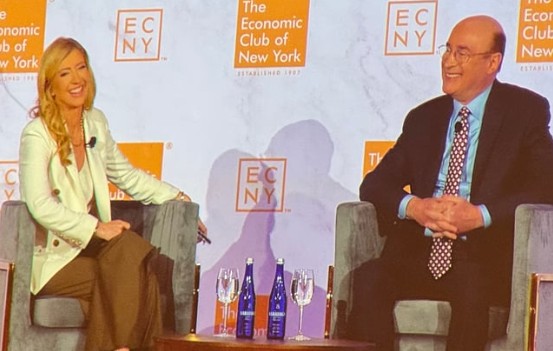
Newscaster Sara Eisen chatted with Brad Jacobs at the Economics Club of New York.
Jacobs also described the road map for growth over the next decade.
“The goal is to get to $50 billion in revenue,” he said to a packed room of several hundred here at the Plaza Hotel in Manhattan. “That’s the next mountain top we're gonna climb.”
To get there, Jacobs says he needs to complete acquisitions that bring in $30 billion to $40 billion in annual revenue, and grow revenue to $50 billion through organic improvements to price, volume and market share.
“So with the $9 or $10 billion we already bought [Beacon’s 2024 annual sales were $9.8 billion], we’re a quarter to a third of the way there already.”
Jacobs, who was speaking as part of the Economic Club’s author series program, is often described as a serial entrepreneur. He founded and led eight companies. His book “How to Make a Few More Billion Dollars” is a sequel to “How to Make a Few Billion Dollars.”
The author of those lofty titles revealed a down-to-earth side to his personality and business philosophy.

Jacobs delivered his remarks to a crowded room at the Plaza Hotel in New York City.
Regarding the 500 M&A deals he completed, he said. “I get credit for this stuff. It's really the team and my teams.”
He added: “We all make mistakes,” he said. “I don't expect perfection in my team. I don't expect perfection in myself. I don't expect perfection in the world. In fact, I expect imperfection every day. I expect all of us to mess up, including myself. So, forgive that and move on. And give yourself permission to be human.”
Home Depot and Lowe's
Asked about the acquisitive behavior of Home Depot and Lowe’s in recent months, Jacobs said he interprets recent Lowe’s comments as an indicator that Lowe’s intends to pause its acquisition streak — maybe for a couple years as it integrates its acquisition of Foundation Building Materials.
As for Lowe’s rival Home Depot, which acquired SRS Distribution and GMS in back to back blockbusters, Jacobs said: “Home Depot has to figure out if this is the right strategy.”
QXO, which is trading on the New York Stock Exchange, intends to bring technology to bear on the building products distribution in a way that will transform the industry.
When his interviewer described building products distribution as a low-excitement field, Jacobs pushed back.
“I find it very sexy,” the QXO founder said. “I looked at about 600 companies over about 55 different industries and this is the first one that literally checked every box. This was the girl I wanted to marry.
What does he like about it? “I think it's a safe bet that building products are not going into the metaverse. I think that that 5 years or 10 years from now, you're still gonna go home to a real physical house with a roof and windows and doors and bathtub.
“And I think over time, because of the shortage of housing and the age of all the commercial and residential houses and buildings, I think there's gonna be a lot of repair and remodeling.”
There are other deals in the pipeline. At any given point in time, he said, there are about 50 potential acquisitions in some stage of consideration or discussion. Currently, there are seven, he said, that have risen to a more serious level.
“Our strategy is not to just look at one deal and fall in love with it and overpay for it,” he said. ”That doesn't work in terms of what we're trying to do. We're trying to create dramatic shareholder value.” One does that by buying companies at a reasonable price, he said, and significantly improving the business after one buys it.
Regardless of the industry, technology is playing a large and increasing role.
“Tech underlies the whole playbook,” he said. “Everything we do to improve a company is related to tech: pricing, procurement, logistics. Everything is tech enabled.”
Not every improvement has a foundation in technology. For instance, organizational charts are often wildly inefficient. (One hundred times out of 100, they will be “messed up,” he said, perhaps exaggerating.)
“We typically find there's too many layers,” said Jacobs, referring to organizational charts and the layers between the CEO and the customer.
Beacon, for example, had nine layers of management, which Jacobs found unworkable. “I wouldn't know how to get anything done.
He described his view on organizational charts this way: They have six or so people running the divisions. And then you have, depending on how big it is, 100 to 200 regional VPs or some similar title. And then you have hundreds or a couple thousand branches or service centers, units stores or locations, and that's all you need.

The lunch crowd heard insights on mergers, management and “How to Make a Few More Billion Dollars.”
“You don't need more than that. You don't want more than that. If you want more than that, it's hard to execute. It's hard just to get stuff done.”
Another issue he found with Beacon is that the roofing supply giant had 1,600 people who had authority to procure, said Jacobs. The QXO founder prefers to be able to count on no more than two hands the number of a company’s centralized procurement officials.
The wide ranging discussion included big ideas (the future of society under the influence of artificial intelligence) and small details (a daily e-mail called QXO am shared by the leadership team each morning).
Jacobs also described the importance of a work force that’s incentivized to perform.
“We don't pay more on the base salary, typically,” Jacobs said. “We love uncapped incentive compensation. Where somebody knocks the leather off the wall, then we pay them. We let them make a lot of money. That's a good thing.”