
The Evolution of Batch Strategies
How Batching Strategies Are Evolving with Automation and Plant Integration
BCMC 2025 Education Session: The Evolution of Batch Strategies
Speakers: BJ Louws, Louws Truss, Inc.; Larry Northway, Engineered Building Design, L.C.
If you wanted a masterclass in how truss plants moved from hand-marked boards to “infinite batch” aspirations, this session delivered. The Evolution of Batch Strategies paired two industry leaders who live this every day: BJ Louws, President of Louws Truss, Inc. and Larry Northway, Production Manager with Engineered Building Design, L.C. The conversational, audience-driven format traced where batching has been, how most plants operate today, and where technology is realistically taking the industry next. The session covered manual beginnings, present hybrid operations, and the infinite batch vision of the future.
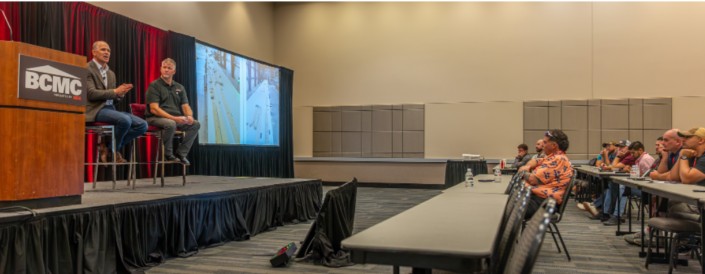
The historical review wasn’t nostalgic for its own sake; it built the context for why plants batch the way they do. BJ described late-1970s and early-1980s workflows simply: 4/12 roofs, 24-foot trusses pulled from a “book,” photocopied cut sheets, and parts pushed through a pull-through saw long before metric-cut systems existed. Crews squared and hand-marked boards, then dialed saws to hit pencil lines. Early computerization didn’t eliminate batching; it produced cut lists that still required big, time-consuming sorts at the table. Larry offered similar memories from another region: wood tables, pits, air-gun stapled plates, and “speed saws” with flip-downs – practices that made big batches feel unavoidable because changeovers were slow and miscuts were costly.
The subject shifted from the past to the present when the speakers addressed what most plants run on currently: some form of hybrid operations. There are still carts and manual batching in pockets; but as BJ noted: while lingering stations still remain, new trends are unmistakable as automated saws, smarter material picking, and tighter batch-to-batch transitions are becoming the norm. What used to take an hour or two of sorting members from a large batch is now targeted in under 90 seconds between batches as a performance goal. That kind of cadence changes everything: how a plant stages wood, what’s expected of design files, and what happens when schedules get tight.
The session highlighted batching constraints as a regional twist turned competitive advantage. BJ’s company is located in Washington State, and they build in order and deliver in order to the jobsite (also referred to as “sequencing”), sometimes against one- and two-hour delivery windows. It adds complexity to the shop floor, but reduces chaos in the field and forces upstream decisions that help eliminate rehandling. Larry contrasted this with his regional experience in Iowa, noting that automation is prominent in many plants, but that on the cutting side, carts are still wheeled to tables. While limitations can impact plant flow, it’s a reminder that the “present” is more of a concept tied to local advancement. Market, building types, old equipment, and facility layout all shape what batching looks like today.
This led to the session’s forward-looking riddle: Is batching about to disappear? The idea of “infinite batching” was floated. When delivering directly to a table, feeding stations with advanced automated systems, batching by definition shrinks. Delivering under- and over-plated members to a predictable station sequence so builders can tack, press, and move produces less work-in-progress and better flow. Auto set-up saws avoid standard-part inventory altogether by cutting what’s needed for the next sequence, which allows only those necessary parts to be sent to the station, which in turn keeps the line moving. This concept sparked an engaging discussion about what a saw can truly feed: one station, one-and-a-half, two? Where does pre-plating pay off? How do you break labor across stations without starving the line?
The session concluded with the realities of plant-field integration. Some markets have general contractors buying components directly, which may appear efficient, but often amplifies risk when the buyer isn’t a wood-frame subject matter expert. The consensus in the room mirrored other BCMC conversations this year: the tighter the CM–framer relationship, the more sense small-lot or just-in-time batching makes, because you can sequence things based on how the building will be framed, not just on how the plant prefers to cut. That also explains rising interest in finished goods sequencing and banding as a key batching factor.
BJ and Larry placed a realistic fence around the future. Yes, autonomous carts and multi-station feed systems are coming, and yes, AI scheduling will make the concept of small, sensible batching a default. But facility constraints, legacy investments, geography, and capital costs mean the path won’t be uniform. Their practical advice was to borrow the future where it fits now: trim changeover time, feed stations in the sequence crews build, and eliminate work-in-progress where auto set-up tools make it safe to do so.
The net takeaway: batching is no longer a static choice, it’s a living strategy tied to how you pick and cut, how parts travel, how crews build, and how you intend for the jobsite to receive material.