
Worker Heat Protections Front and Center During House Subcommittee Hearing
Originally Published by: Safety + Health Magazine — September 2, 2026
SBCA appreciates your input; please email us if you have any comments or corrections to this article.
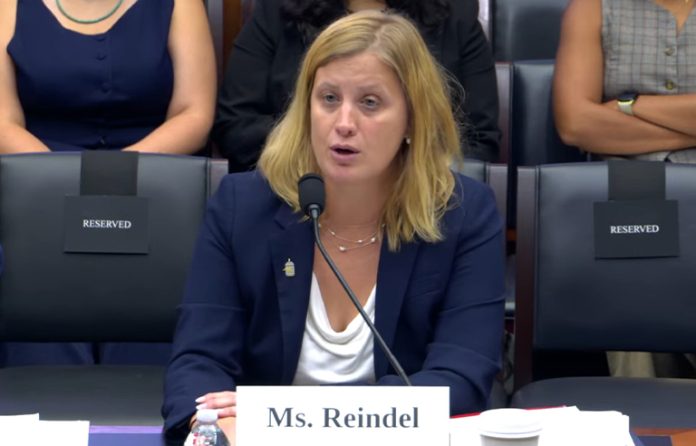 Rebecca Reindel, director of occupational safety and health for the AFL-CIO, testifies Sept. 2 before the House Workforce Protections Subcommittee. Photo: House Workforce Protections Subcommittee
Washington — OSHA’s proposed rule on heat illness and injury prevention was in the spotlight Sept. 2, when the role of federal regulation was debated during a hearing convened by the House Workforce Protections Subcommittee.
In her written testimony, hearing witness Elizabeth Milito, representing the National Federation of Independent Business, urged Congress to pass a recently introduced bill that would prevent the agency from going forward with any heat rule – now or in the future.
The House Education and Workforce Committee, which the Workforce Protections Subcommittee is a part of, on July 21 approved that bill, known as the Heat Workforce Standards Act of 2025 (H.R. 6213), advancing it to the full House.
Even if the House were to approve the legislation, it would still need to pass the 60-vote threshold in the Senate, which would require the support of seven Democrats even if every Republican voted in favor of the bill.
Milito touted the General Duty Clause as a way to protect workers from heat-related hazards in lieu of a standard. However, Rebecca Reindel, director of occupational safety and health for the AFL-CIO, stressed that the clause has a “broader, higher burden of proof” than a regular OSHA standard, namely a four-part test that the agency needs to satisfy to issue a citation:
- The employer failed to keep the workplace free of a hazard to which its employees were exposed.
- The hazard was recognized.
- The hazard was causing or was likely to cause death or serious physical harm.
- A feasible and useful method to correct the hazard was available.
An OSHA heat citation that used the General Duty Clause was reversed in 2019 by the Occupational Safety and Health Review Commission. In that case, Secretary of Labor v. A.H. Sturgill Roofing, OSHRC wrote that OSHA failed to meet at least two parts of the test: the existence of a hazard and a feasible means of abatement.
The death of a 60-year-old worker occurred when the temperature was 82° F with 51% relative humidity. Citing a National Weather Service chart, OSHRC ruled those conditions put the heat index in the “caution” range.
“As to the extent of exposure, the evidence shows that the heat index values were at most in the caution range for two of the five hours the crew worked on the day in question,” the decision states. “Yet, we cannot determine if two hours in those conditions constitutes ‘prolonged exposure’ because the secretary does not establish what the NWS means by ‘prolonged exposure’ – in fact, there is no record evidence on this issue. Nor does the record establish that the work performed by Sturgill’s crew was ‘strenuous.’”
Lawmakers and witnesses also discussed child labor laws; joint employer and independent contractor rules; and the Mine Safety and Health Administration’s silica rule, enforcement of which is on hold “indefinitely.”
The hearing included testimony from Austen Bannan, an employment policy fellow from Americans for Prosperity, and Douglas Holtz-Eakin, president of the American Action Forum.