
U.S. Sawmill Expansions Emerge
Originally Published by: HBS Dealer — September 17, 2026
SBCA appreciates your input; please email us if you have any comments or corrections to this article.
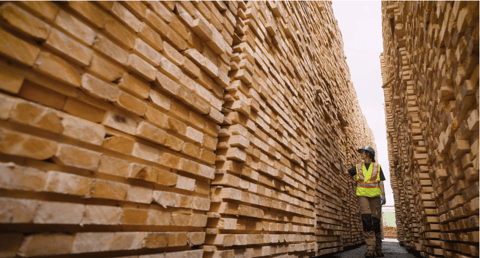
After a spike during the COVID years, U.S. sawmill production has declined. According to Federal Reserve data, U.S. sawmill output dipped in Q1 2026—the second consecutive quarterly decrease.
But there are a handful of mills bucking the trend.
Irving expands in Maine
Irving Forest Products, Inc., a subsidiary of J.D. Irving, Limited, is undertaking a modernization project to expand its Ashland Sawmill in Nashville Plantation, Maine.
When complete, the project will double the facility’s annual lumber production capacity from 130 million to 250 million board feet worth of dimensional lumber. The project is expected to create and retain the equivalent of 220 permanent, full-time jobs.
The project is supported by the Federal New Markets Tax Credit (NMTC) program and the Maine New Markets Capital Investment Program, which together bring a combined total of $112.9 million of tax credit allocations to the project to help bridge a funding gap by stimulating private investment.
“The Ashland expansion is an important investment in the future of Maine's forest products industry and the communities that depend on it,” said Jim Irving, CEO of J.D. Irving, Limited. We are grateful for Senator Susan Collins, whose continued support for economic growth and modern rail service in Maine has helped create opportunities for investments like this one.”
Rebirth in the Sierra Nevada
In July, the USDA awarded $50 million in TPEP and Business and Industry Guaranteed loans to Tahoe Forest Products, LLC. in Nevada, in partnership with MapleMark Bank, to assist the business to expand processing capabilities, including kilns, utilizing timber from Nevada and California, a planer mill, and a new saw line.
According to a Las Vegas news outlet, roughly 90% of mills in the area went bust during the timber wars of the 1990s, adding that "Tahoe Forest Products is now the first significant sawmill in the region in several decades."
Tahoe's expansion will enable the business to shift from raw material production to finished lumber suitable for sale to retail distributors and large-scale construction markets. In addition, the business will increase its capacity for lumber production from purely rough lumber to premium lumber by 60,000 MBF.
Growth down South
Sawmill operator The Lumber Manufactory recently located a sawmill operation in New Albany, Miss. The project represents a corporate investment of more than $15 million and the creation of more than 50 jobs.
TLM constructed a sawmill in New Albany to make use of Mississippi's abundant pine sawtimber, which the company says was a key factor in the decision to locate in the state. The New Albany location also creates new opportunities for private landowners to sell their timber.
The Mississippi Development Authority is providing assistance through the Mississippi Flexible Tax Incentive, or MFLEX, program. AccelerateMS and Union County also are assisting with the project.
The company's New Albany facility is now operational.
In Louisiana, meanwhile, C&C Forest Products is investing over $21 million to rebuild its Coushatta sawmill following a 2025 fire, repositioning the facility as a more efficient, cost-competitive specialty lumber and timber operation.
The project will reconfigure the existing facility at 306 Wilkinson St. with updated equipment and improved site layout to support more efficient production. Once complete, the rebuilt sawmill will focus on specialty lumber and timbers and will be capable of producing up to 90 million board feet annually, enhancing the company’s ability to serve regional and national markets.
In Alabama, two companies have also recently received USDA support to bolster operations. Keller Lumber earned a grant of $300,000 to expand lumber drying capabilities to support markets for 5 million board feet annually.
Swift Lumber, meanwhile, won a grant to upgrade sawmill production technologies to process over 260,000 tons annually, including on the Conecuh National Forest.