
Vacant Developed Lot Supply Continue to Increase
Originally Published by: Zonda — May 11, 2026
SBCA appreciates your input; please email us if you have any comments or corrections to this article.
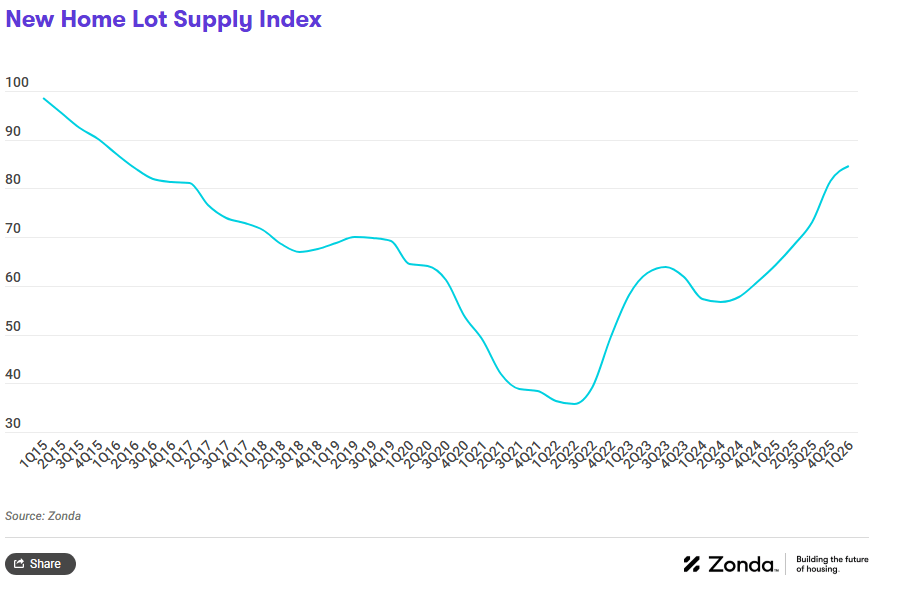
Zonda’s New Home Lot Supply Index (LSI) for 1Q26, rose for the seventh consecutive quarter and showed lot supply loosened both year-over-year and quarter-over-quarter across the United States. The index is a residential real estate indicator based on the number of single-family vacant developed lots (VDL) and the rate at which those lots are absorbed via housing starts.
- The New Home LSI came in at 84.6 for 1Q26, representing a 31.6% increase from 1Q25. Last quarter marked the first time since 2017 that the national market shifted from “significantly undersupplied” to “slightly undersupplied.” This quarter, the market remained “slightly undersupplied.”
- On a quarter-over-quarter basis, supply increased by 3.7% from 4Q25.
- The LSI counts the total vacant developed lot supply and adjusts it for overall starts activity.
“Lot supply is loosening as builders respond to a softer demand environment,” said Ali Wolf, chief economist for Zonda and NewHomeSource. “Affordability remains stretched, and consumers are cautious amid economic uncertainty and geopolitical risks. As a result, builders have pulled back on starts in many markets, allowing vacant developed lot supply to build. Importantly, though, this doesn’t signal national oversaturation. Rather, it reflects a supply and demand balance that is moving closer to ‘normal’ after years of unusually tight lot conditions.”
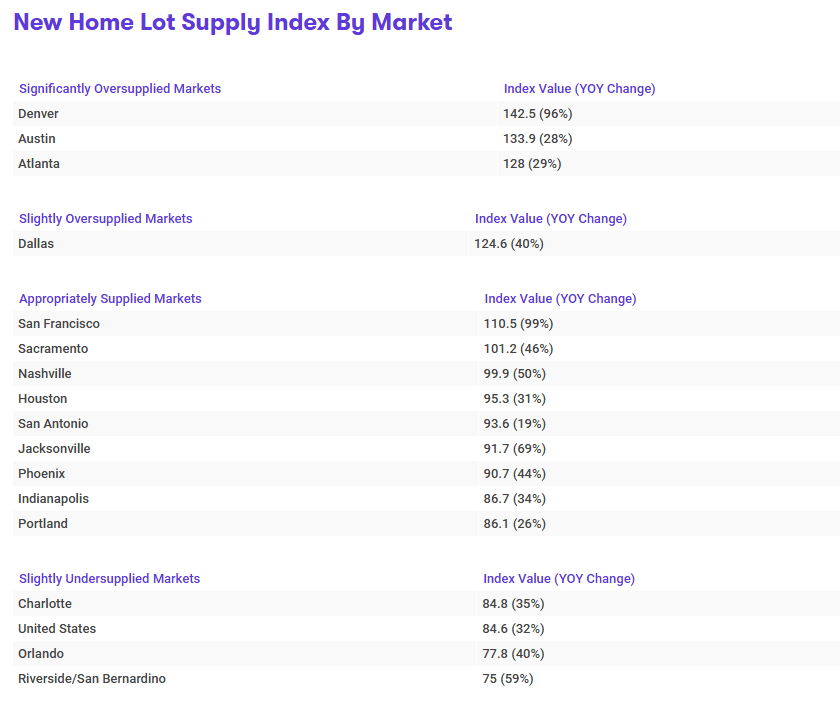
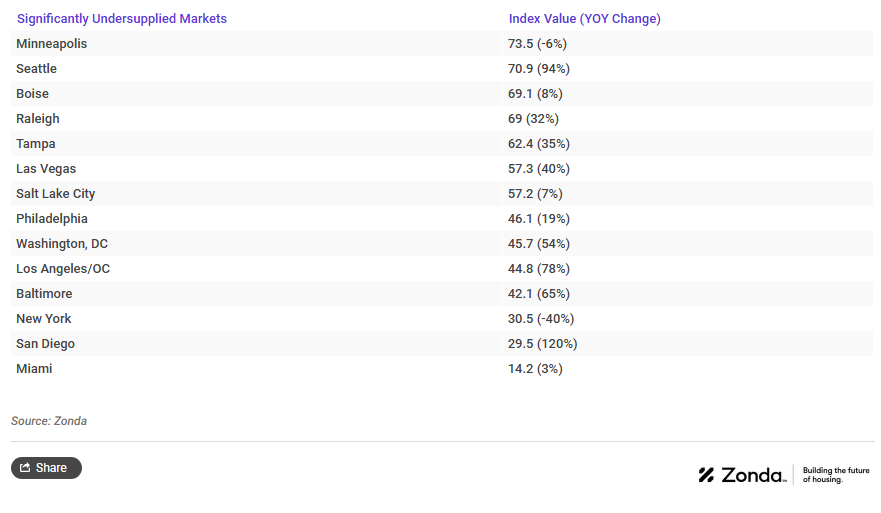
Lot supply loosened year-over-year across nearly all major metropolitan areas, with New York and Minneapolis the lone exceptions, the same as last quarter.
- More markets trended up and were rated “appropriately supplied” or “oversupplied” in the first quarter, but 14 of 30 were still categorized as “significantly undersupplied.”
- The markets where land supply loosened the most on a year-over-year basis were San Diego, San Francisco, and Denver. Related, 1Q starts were down over the same period in all three markets, with San Diego posting the largest decline at 31%.
- New York tightened the most compared to the same time last year, falling 31.7% to 30.5, and was rated “significantly undersupplied.” Miami and San Diego continued the trend of being the tightest lot markets in the country.
- Denver, Austin, and Atlanta were the top three markets for loosest lot supply in 1Q, with Atlanta moving up to a “significantly oversupplied” market to join the other two. This marks the second consecutive quarter where a market moved into the “significantly oversupplied” category, which hadn’t been true since 2017. Dallas was the lone “slightly oversupplied” market, while nine others were “appropriately supplied.” The remaining 17 markets were “undersupplied.”
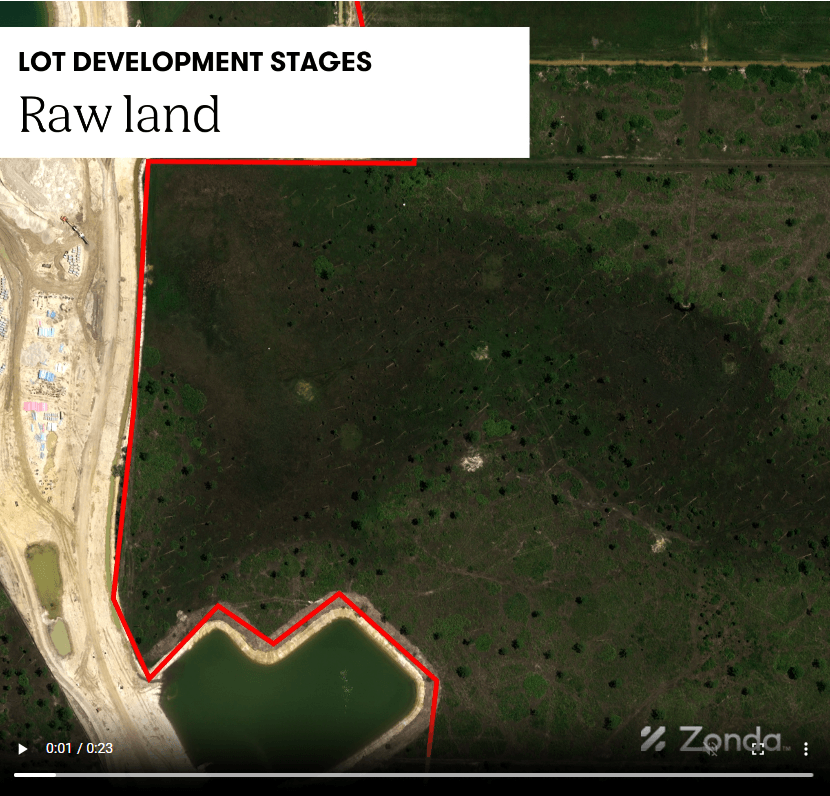
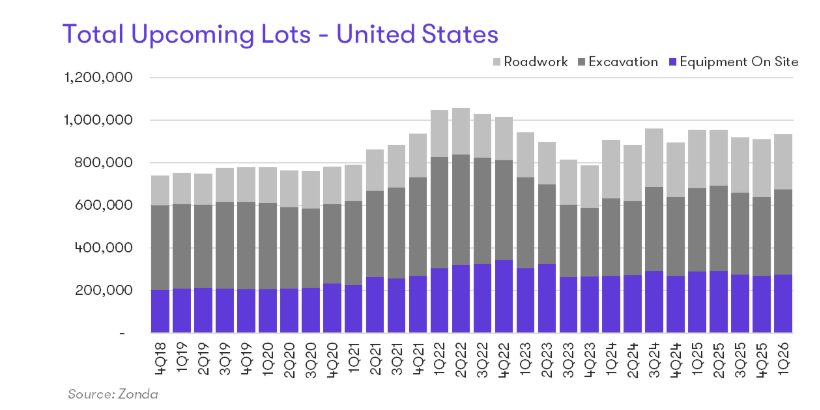
Zonda also records future lots through the stages of development. The stages range from raw land through streets in, which is the last step before the lot becomes a vacant developed lot. Zonda groups the last few stages into a classification called total upcoming lots, which typically indicates delivery over the next 12-18 months.
Click the image below to view the full slideshow
Total upcoming lots in 1Q26 decreased 2.2% year-over-year but increased 2.7% quarter-over-quarter. These types of lots in the first quarter were down 11.7% from the 2022 peak but were up 24.1% compared to the same quarter in 2019.
Among total upcoming lots, roadwork was up 4.8% year-over-year. Roadwork is comprised of the two smaller stages–streets paved and streets in–and represents the last step in lot development. Lots in the excavation stage were down 0.4% year-over-year, while those with equipment on site were up 0.7%.
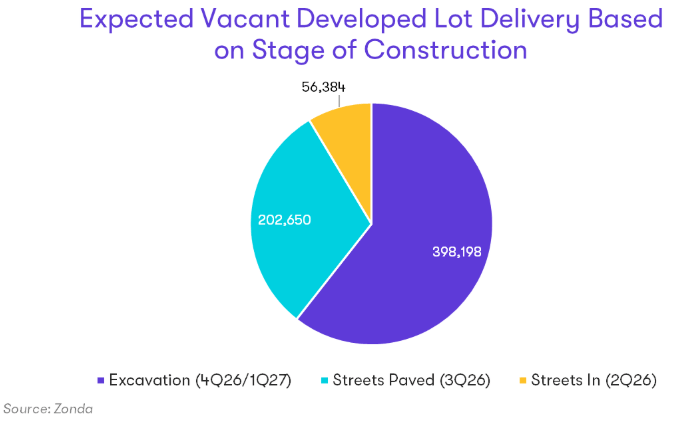
The largest share of total upcoming lots were in the excavation stage in 1Q26, totaling 398K. These lots have an expected delivery between 4Q26 and 1Q27 (the range represents different timeframes from local entitlement processes). Note, not all of the lots in excavation will match Zonda’s estimated timeline.
“Upcoming lot activity suggests the industry is taking a more measured approach, showing relative stability over the last two years,” Wolf said. “The development pipeline is still active, but it has come down from the 2022 peak, which is appropriate given today’s slower sales environment. The key is balance, though, where builders need enough lots to be prepared for shifts in demand, but they also need to avoid pushing too much supply into markets where buyers remain cautious.”
Read past reports
Are you interested in reading past New Home Lot Supply Index reports? Access our report library to learn more.
Go deeper with Zonda Advisory services
Get more granular custom housing market data based on your region and your business needs. Learn more about our Advisory services to see how we can help you level up and meet your goals.
Methodology
The Zonda New Home Lot Supply Index (LSI) is built on proprietary, industry-leading data that covers the production new home market across the United States. The index values represent single-family vacant developed lot supply, lots that are ready to be built on, relative to equilibrium. Released quarterly, the New Home LSI provides an unrivaled look into the lot markets across the country, offering a current quarter snapshot as well as insight into the directional trend.
The New Home LSI is calculated based on each markets’ specific equilibrium as determined by our team of local experts and historical activity. The comparative current value is adjusted to capture the “true” months of supply figure by applying a greater weight to vacant developed lots in subdivisions with more starts activity. Each index value is associated with a phrase highlighting the current lot supply dynamics. A value of 100, represents perfect equilibrium, while a value of 125 and above equals “Significantly Oversupplied”, 115-125 – “Slightly Oversupplied”, 85-115 – “Appropriately Supply”, 75-85 – “Slightly Undersupplied”, and 75 and below – “Significantly Undersupplied.”
The foundation of the index is a quarterly release conducted by Zonda. It is necessary to monitor residential lot supply to understand how new home markets may be impacted by the incoming pipeline.